In 2020 I finished a MSc in Systems Thinking in Practice, the final step being a research project which focused on the aspects of virtual teams and remote working. It's how I've worked for the majority of my career and a topic I think about a lot.
I finished the research while coronavirus was erupting, which was as timely as it was frustrating; as I couldn't share the research straight away (due to university rules on plagiarism and sharing before marking).
Because of covid-19 I've seen many posts and articles for workers who are new to remote teams, or home working. Most of these are focused on the individual and their working day, ergonomics, routine, etc. Which is great, though, I think they're mostly subjective and a little prescriptive, opposed to informative.
I believe it's best for each individual to use those kinds of posts as a starting point and explore what works for them and their team. There are many different modes of working, as well as types of team interaction.
This blog post is a summary from my MSc research paper, which shares the nature of distributed teams, and what topics I found the research to show is important.
My focus was guided by some questions, a few being:
- What matters in a virtual team?
- What are the emergent properties and issues of virtual teams?
- What are the common dynamics within (distributed) work teams?
Terms
First I'll try and clarify some terms I'm going to use. Ensuring a shared meaning (mental model) is one of the many important aspects of virtual teams; same words and different understandings lead to all kinds of issues that most of us can relate to.
Distance has many dimensions as we'll talk about later — geographical, temporal, cultural and so on. For example a remote team "has more geographical distance" than a co-located one.
For example, one part of a global team based in New York City will have geographical as well as cultural distance from another team based in Seoul.
Virtual team is used to refer to two or more people who have geographical distance, though work together to achieve a goal.
Organisation is the company, e.g. Google.
Team will be relative to the size of the organisation. A "team" in a large organisation could be "the group of developers, designers along with a project/product manager that take care of product X". Though in a smaller company or start up (which is where most of my experience is) team and organisation are interchangeable.
When I say team, I typically mean organisation as well depending on the size of team/company. Pick whichever makes sense. My findings are the same, it's just a matter of perspective.
Why did I do it?
I have spent the majority of my career and life in virtual settings (opposed to a physical office). I have been in offices on occasion, though I've already shared my views and research on them.
Over the last 10–15 years most of my time and focus has been thinking about others and what they need. Trying to figure out the balancing act that is management, facilitation and leadership. What are all the factors that go with being responsible for supporting a team and facilitating an outcome.
As I had to deliver a research project to finish my MSc, I wanted to use the opportunity to spend the time focused on something I really care about. Which is the way teams (and the members of them) interact and work together. How can it be done better? What are the issues and barriers to success? What pisses most people off?
I've been extremely lucky in a few teams, as we experienced flow simultaneously. I strive to share that with team mates as well as experience it again myself. I'm also very sensitive to behaviours and attitudes (conscious or otherwise) that stop a team getting there. So continuing to improve my understanding of this is important to me.
So, it's personal, it's something that fascinates me and I do it for a job.
Evidence supports that the world is moving towards remote work (where people can) long before covid-19, so I want to share some insights where I can to help out.
I saw a headline during this write up that sums it up:
"The biggest coronavirus challenge? Getting us all to ditch homeworking and come back to the office."
What was the research, how did I do it?
I took the route of Secondary Research, that means I used the data that others have gathered, opposed to doing the data gathering myself.
Pros — I get a lot of data to use for the research.
Cons — It's not 100% focused on answering the questions I'm asking.
So, the dry academic aim of the research was:
"To investigate the barriers to organisational performance within distributed agile software development teams."
I had to focus on a certain type of team, so focused on my own experience. Though I found the research is relevant to any type of remote, virtual or hybrid team.
How
I think a quick overview of the "how" will help to give some legitimacy and context to what's coming. I've cut out all the dry academic ground work for sanity ...
I combined three theories in the research, to guide the data gathering (from peer reviewed journals). I focused on the three that I know about:
- Project Management (PM)
- Group Dynamics (GD)
- Communications (CM)
Then I went on the hunt for relevant peer review journals published since 2000. I found 150 and filtered it down by measuring relevancy and quality to 90, to make sure the data was good enough.
From each of the 90 documents I extracted the supported arguments or proven hypotheses and turned them into "statements".
A statement is one word or a short phrase, to paraphrase what was being said by the document.
Creating statements made it possible to group data from the disparate documents together and then count how many times they occurred. I did this for each of the theories and then ranked the statements.
Reading that many journals gave me a ton of insight to aspects of each theory I'd not considered before, though the main goal here was to find the statements that occurred in each of the three theories (I called these "core statements").
For me, that intersection of the theories, was the mental Venn diagram I was after, i.e. What is each theory saying is important?
At the end of all that I had a list of ranked statements from each theory and the ones that appear in all three.
Then I wanted to create a simple diagram, to be able to picture my findings. Also this would allow me to try to communicate how the core statements interacted from all the research I'd done.
Findings
Caveat — I've removed a LOT of the details and nuance to get this down to a readable blog post size. I could likely add several volumes just on the different types of communications and what the research shows works best in different teams and environments.
Well this diagram is the fun bit, I hope this helps others who are responsible for facilitating virtual teams. This is new to some, old to others, but is certainly not going away and a lot of organisations need to get a lot lot better at it.
All the core statements from the intersection of all the theories, turned into this diagram:
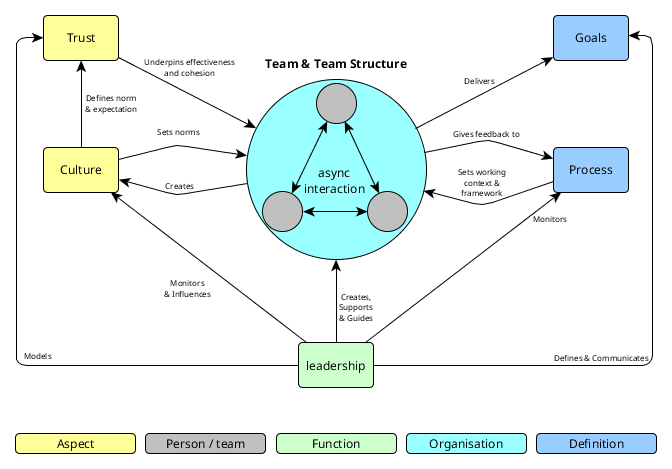
So the 7 core statements that came from all the research were:
- Team & (the) Team Structure
- Goals
- Process
- Leadership
- Culture
- Trust
- Asynchronous Interaction
Team & Team Structure
Existing research shows that the creation of a team goes beyond selecting a set of individuals with the appropriate skill sets, but to the psychology of shared identity. The formation of a team and its accepted norms helps to define its boundaries and culture.
The research found conflicting findings on the physical distance in distributed teams being a negative impact. Though the majority of the findings suggested that the geographical distance is inconsequential. The method and quality of the communication, as well as training, were found to be more impactful than distance barriers. The evidence that some highly performant distributed teams outperform co-located teams supports this.
One document indicated a tendency for conflict to emerge more in distributed teams, opposed to co-located ones.
It's vital to understand the importance of proactively building a team structure to mitigate conflict, as well as instilling a shared identity and culture.
Process
Marks et al. (2001) describes process as:
"member's interdependent acts that convert inputs to outcomes through cognitive, verbal, and behavioural activities directed toward organizing taskwork"
Process ranked very highly in the research — in all areas — but this doesn't mean that there has to be a very complex heavy process. But that there should be a suitable, well communicated and understood one.
A process is an organisational tool, different tools are suited to different organisations. Treat anyone who claims to have "the one true answer" with a healthy amount of suspicion (i.e. die hard agile evangelists, who — quite ironically — by nature and view are quite rigid).
Goals
The description of process includes the behavioural activities by which a team attempts to deliver their goals. The findings throughout the research spoke to communication having distinct (and usually unrealised) goals.
Some describe the primary goal of communication being about sending clear information. The issue with this is that it focuses on broadcasting information and not on ensuring that the people receiving it have the same understanding as the sender.
Qualifying with people what they have understood is vital, this is why shared mental models matter.
The work demonstrates the value of not only clearly defining and communicating team goals, but proactively sharing them to teammates.
The approach of broadcasting information to increase team members' situational and workload awareness is observed in superior teams.
Research states: "consciously set goals can increase employee performance". This aligns with the findings extracted during this research.
The focus on goals in all three theories is indicative of the importance of having an understood intent in communication, action and outcome.
In summary — as a team (or via leadership), set very clear goals and communicate them to the team. A common (and I think good) model is OKR which then feeds into each team and team member.
Leadership
Leadership (not surprisingly I hope) was found to be vital in all areas of efficient and effective teams.
It was also observed that leadership — as a property of a team — isn't necessarily represented consistently by a single person or group. Rather that leadership is an emergent property and that it can be fluid.
Meaning that it can move amongst suitable members of a team depending on project context.
Not only is leadership vital and potentially fluid within a team, but also needed to be multi-dimensional.
This is due to the multitude of dimensions in distributed teams. Research created a convenient diagram of the dimensions:
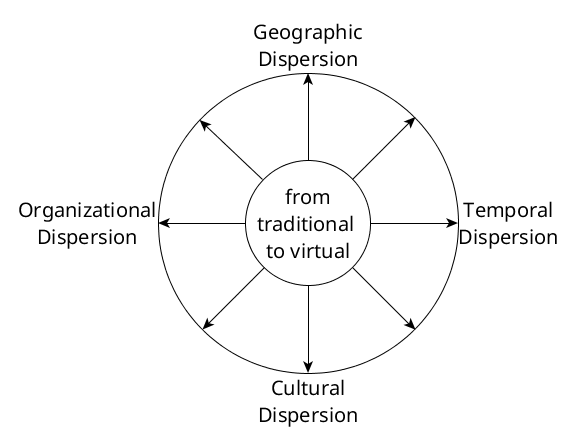
These dimensions of a team are one aspect and how disperse they are is the measurement. It's not just geographical distance (which infers time) but also culturally and organisationally, i.e. accounting and engineering having a day to day working distance within an organisation.
The insight was to not think of a team on any dimension (geographical, cultural, etc) as one extreme or the other. Remote or not, but on a continuum.
So a co-located team has a low dispersion of geographical difference, where as team members around the world have a high dispersion. This can also be in flux as some members work in an office a few days a week and at home for the rest, so over time the dimensions change.
Having a scale and seeing our own place on it can help with team context and self-awareness. Which is a good way to mitigate the dreaded "us and them" (in/out group) thinking that can occur in teams, virtual or not.
Culture
Culture has been described as:
"one of the VT's most significant boundaries."
There are thousands of books and millions of blog posts on culture and I'm not here to define what is a "good" or a "bad" one, only that we should be mindful of the cultures we cultivate.
I'd suggest being wary of ideologically driven missions from teams/people trying to enforce their narrow view of what is an appropriate culture. Apply a large amount of critical thinking to the motivations of such initiatives.
Culture was found throughout the research and is the main contributor to trust within a team. The dimensional complexity of culture increases a LOT within distributed teams. This is because different groups have different norms and local cultures, as well as the cultures of the countries they live in.
During the extraction of Project Management and Group Dynamics findings, many documents indicated the issues that occur from a lack of understanding (opposed to prejudice or hostility) of the different cultures within a team. Not only with a co-located team, though more frequently between geographically dispersed teams.
Culture directly underpins and affects the ability for a team to innovate and contributes significantly to the development of trust within a team.
The documents showed a close relationship between culture, team building and trust.
This is no simple topic ... and I suggest it's for the leadership to figure out asap if it's not already there.
Trust
Trust is a vital component of a harmonious team, basically the foundation for everything. If you don't have this, there isn't much else that matters.
It's likely the hardest aspect for inexperienced or weak leaders to deal with. Not trusting members of the team quickly leads to a breakdown of all other aspects of the work and interactions.
Trust is described as:
"the willingness of a party to be vulnerable to actions of another party based on the expectations that the other will perform a particular action important to the trustor"
As with leadership and culture, trust was shown to be multi-dimensional. Research describes two types of trust, Personal and Abstract trust. Personal coming from relationships within the team and Abstract being based upon the structures of an organisation.
Asynchronous Interaction
Asynchronous behaviour is an interaction that isn't dependent on immediate response. In distributed teams this will typically be out of necessity due to time zone differences. Email was the most common example of asynchronous communication in the findings.
Though Slack, Microsoft Teams, etc are all good examples as we can't be working in a manner which is dependant on others all the time, and this should be minimised as much as possible.
Much as most meetings are a waste of time, trying to "get everyone on a call" is usually the same waste of time.
Asynchronous working was shown to lead to more knowledge capturing and transfer due to the medium of transfer being recorded (email, PM tools and Slack chat). Asynchronous is core to distributed teams' communications and process, group dynamics and project management.
With distributed teams commonly working (globally) at different times, figuring out the best asynchronous practices will benefit everyone.
Summary
So, those 7 core statements were my findings for the aspects that affect teams. Teams with various dimensions of distance (geographical, cultural, etc) will experience each of the dimensions in different ways, though each aspect will be present and should be considered by the members, be they facilitators/leaders or not.